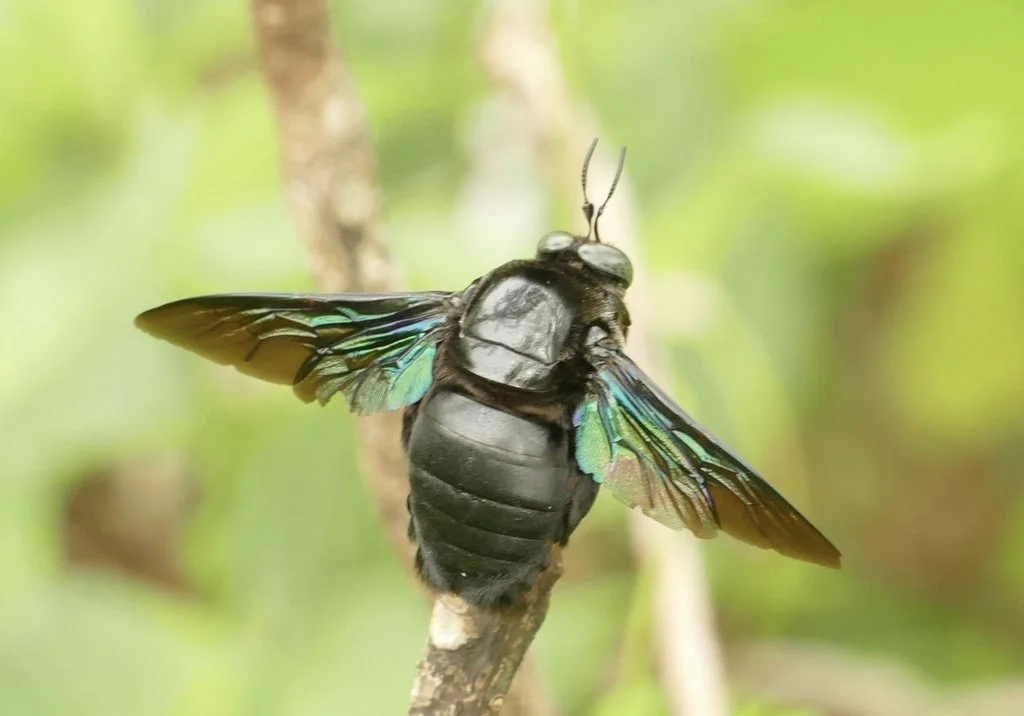
I am lying outside on our battered and dusty old sofa listening to music when a movement catches my eye. It’s the welcome return of Beatrice. She comes in fast, swooping under the hanging baskets, skimming over the table, then hovering effortlessly next to an old umbrella stand filled with wooden sticks. Once she has her bearings, she crawls into a small, but almost perfectly circular, hole etched into the face of one particular pole.
Beatrice heading out to look for pollen.
Beatrice is a carpenter bee. These oversized members of the Apidae family are chunky flying tanks, coming in at around the size of a thumb and emitting a deep and throaty hum as they drone from flower-to-flower. For the last eight months or so Beatrice has charmed my family, after taking up residence and then starting her own brood in the front yard of our terraced house in central Singapore.
We first thought we had a bad case of woodworm, after an ominous pile of sawdust appeared at the base of our wooden umbrella stand – which, ironically, has housed toy swords, kites, and plenty of sticks collected on family walks, but never an umbrella. I even went so far as to buy some spray to tackle the infestation, but fortunately I am incredibly lazy, so never got round to it.
Then we started to hear strange rattling noises emitting from the area. Was it a resident gecko, cockroaches, or a particularly weird form of haunting? The truth became apparent once we noticed the hole, which was about the diameter of a 1p piece (SG$1). Peering inside, we were confronted by the furry feet and iridescent black thorax of a bee, whom we quickly christened Beatrice.
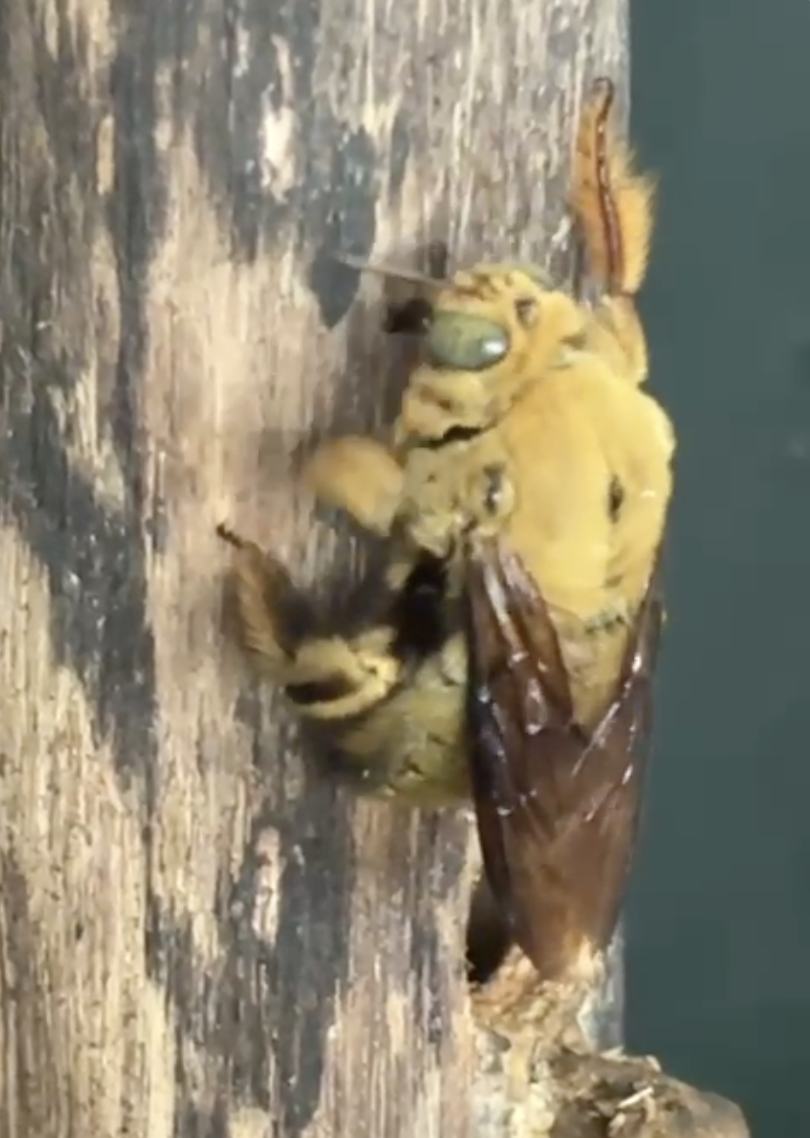
One of Beatrice’s offspring and an example of a male Broad Handed Carpenter Bee
Some online investigation taught us that we had ourselves a resident Broad-handed carpenter bee (Xylocopa latipes). Well we think so anyway, though it might also be a Yellow-and-black carpenter bee (Xylocopa flavonigrescens). I am far from an expert entomologist and there are actually 13 different species of this type of bee in Singapore, many of which look very similar, but she certainly matches the description on the various nature blogs I’ve studied.
Indeed, I’ve become much more knowledgeable about carpenter bees of late. Ever since that first encounter, we have spent a large chunk of our free time sat outside studying Beatrice and learning about her behaviour. For example, I’ve learnt that carpenter bees are mostly solitary, rarely sting, and don’t form large colonies or hives like honeybees. Instead, I have been able to observe first-hand their preference to excavate tunnels in dead wood, or wooden structures like decking, creating a series of partitioned galleries where females make brood cells to lay their eggs. Once the larvae hatch, they are then sustained by a store of “bee bread” – a mix of pollen and nectar – which we watched Beatrice diligently stock-pile through her multiple trips back and forth to the neighbourhood’s flowers.
From one bee we now have a family of three who spend their days clicking and clacking in the nest or buzzing lustily past our ears as they head out to look for nectar. Originally, they shared the original hole but have since carved out a back door on the other side of the stick. Over the weeks they’ve also grown, with the youngsters getting more confident in the air as they swoop in and out of our porch – though there are still occasional moments of drama when they recklessly wander into our living room – with its twin hazards of fast spinning ceiling fans and a cat.
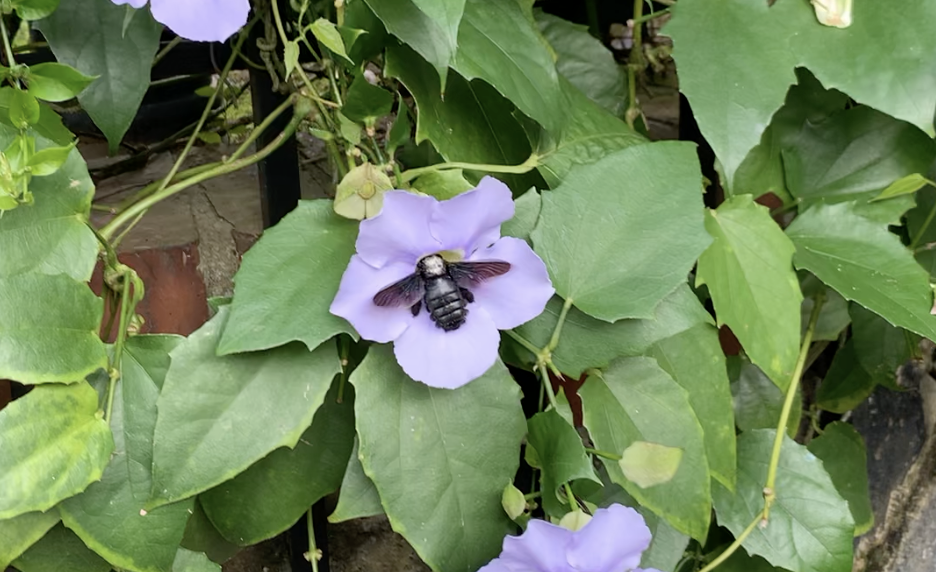
A Carpenter Bee (not Beatrice) doing what bees do
In the most recent development, the offspring have spent this weekend scrapping over who gets to call the main hole home – or potentially another type of carpenter bee (covered in yellow fuzz) is trying to muscle in on this prime real estate. There are even signs of a new nest appearing on a neighbouring stick, which we helped to accelerate through the removal of its tough outer layer of bark. Hopefully, these are signals that the next generation will soon by expanding our bee family yet further.
And they really do feel like part of a family, and aside from the odd shriek when their sheer size and low-level flying has alarmed a visitor, it has been a perfectly harmonious relationship. Indeed, the arrival of Beatrice has been a genuinely fun learning experience.
It has also served as a bit of motivation to finally get back to doing some writing. The usual excuses of work, travel, and my continuing volunteer work for ACRES and different conservation projects, haven’t helped, but being honest I also just haven’t felt the motivation. But watching Beatrice and her children simply go about their daily lives in the middle of a bustling urban neighbourhood, has inspired me to stop overthinking, or waiting until conditions are just right, and instead just get on and do something – very bee-like behaviour. They’ve also reminded me to focus on the small stuff, because, as we’ve all seen in recent weeks, you really can’t do much about the big stuff anyway.
Being able to travel the world and write about the places of rich biodiversity and natural beauty I get to visit is obviously a joy and a huge privilege – and I do hope to start sharing some recent experiences again soon – but the simple reality is you don’t actually need to go far to enjoy inspiring wild encounters or discover how amazing the natural world really is. You just need to take the time to stop and look a little closer at what’s already around you.
Even in the middle of a crowded and urbanised island like Singapore, a few metres from a busy road and a crowded row of shophouses, you can still find nature going about its business - I haven’t even mentioned the resident bats and the deafening nightly spectacle of roosting mynahs outside our local supermarket!
Thank you, Beatrice, for teaching me that lesson from the comfort of my front yard.
Beatrice coming into land in slowmo